-900x216.jpg)
Early Years
Our Vision:
To provide a safe, nurturing and stimulating learning environment for everyone. We believe that the experiences children have at the very start of their school life are important in ensuring that they grow up as independent, resilient and self-motivated learners for life.
To ensure that every ‘child can thrive’ by recognising and valuing children’s strengths, talents and individual interests. We place an emphasis on speech, language and communication, ensuring that every child achieves and reaches their potential.
To provide an excellent and enjoyable education where each child is valued & enabled to achieve the highest possible outcomes. The children are provided with an inspiring early years classroom and outdoor environment to facilitate learning.
To provide children with the skills and knowledge for the next stage of their learning journey and into adulthood.
Intent:
At West Town Primary Academy, we aim to give all our children an exciting, challenging and meaningful start to their learning journey with us. We plan children’s learning experiences in accordance with the Early Years Foundation Stage (EYFS) curriculum guidance and principles and it is designed to recognise children’s prior learning and their experiences at home. We strive to provide a creative, discovery and play based curriculum which takes in to account the children’s existing skills, knowledge and interests based on quality first-hand learning experiences allowing the children to build resilience, ambition and compassion. Every child is recognised as a unique individual, and we celebrate and welcome differences within our school community. The ability to learn is underpinned by the teaching of basic skills, knowledge, concepts and values. Within our everyday practice we provide enriched opportunities for children to engage practically in their learning and believe that their first experiences of school should be happy and positive. We aspire to inspire our children to have a love of learning with the resilience and skills to succeed
The children are encouraged and enabled to make choices about their own learning both indoors and outdoors. Through the learning opportunities and environments we provide, our children become active learners who develop strong enquiry and practical skills as well as becoming personally and socially confident individuals who enjoy learning.
The EYFS is made up of seven areas of learning that are inter-connected. The three prime areas which are Communication and Language, Physical Development, and Personal, Social and Emotional Development. Children entering the Foundation unit this year have required an extended length of time to settle and secure development in the prime areas. This has been a priority due to the length of time the children were out of pre-Reception settings or did not attend an early years setting prior to starting school. Many children have therefore entered Reception below expected in these key areas of their development especially their independence skills and resilience. There are also four specific areas, through which the three prime areas are strengthened and applied. These are Literacy, Mathematics, Understanding of the World, and Expressive Arts and Design. All these areas support the children in progressing towards attaining the government’s statutory end of year Early Learning Goals.
Modelling and supporting social and communication interactions are key in developing these areas as is implementing interventions for speech and language and listening and attention. We know that children have varying life experiences and sometimes limited opportunities to experience enriched activities in the local community and beyond. Throughout school, wherever possible, learning is based on real-life experiences for all pupils. Bringing the curriculum to life is not only promoting a love of learning, but also providing enriching experiences which have an impact on children’s development. When children learn in nurturing and fulfilling environments they feel secure, confident and capable of dealing with later challenges, developing self-esteem, confidence and resilience.
We have designed our curriculum goals with the particular strengths and needs of the children in mind. They provide an overview of many of the different things we would like children to know and be able to do. Each curriculum goal follows a progress model.
- To settle in, feel safe, secure and become a confident learner.
- To express and explain my feelings and ideas in words.
- To retell a known story in my own words.
- To combine different movements within a dance.
- To show accuracy and care when drawing.
- To create a 3d model using construction materials.
- To play a game of number bingo.
- To show curiosity by asking questions.
Implementation:
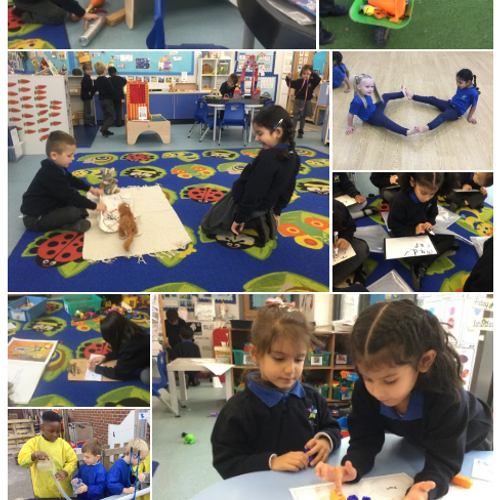
We acknowledge that the best outcomes for children’s learning occur with a mixture of child- initiated play, focused group work with adults guiding the learning through playful, rich experiential activities and provide a carefully thought out stimulating environment with different areas for the children to explore and develop their knowledge and skills. Through the children having continuous access to a wide range of resources including construction, small world, sand, water, creative arts, role play, mark making, stories and reading, dance, music, drama we encourage independence and skill development, both fine and gross motor. We help the children to understand the importance of physical activity and a healthy lifestyle, including oral healthcare.
The new EYFS Curriculum encourages Practitioners to spend time with children and get to know them as individuals so they can follow the children’s interests and can adjust the curriculum and environment to reflect ‘in the moment’ interests and further embed and develop concepts. They understand how the different elements of the curriculum fit together to help children build on their learning over time. Through a secure understanding of child development, practitioners judge when to get involved, when to encourage and how to scaffold children’s learning without over-helping them.
We work in partnership with parents/carers, ensuring their voice is part of both the learning and assessment of each individual child. They are supported with how to help with their child’s learning at home as well as in the setting by inviting them to a reading club and take part in teaching sessions with their children.
The children are provided with many varied experiences which develop and challenge their understanding about the world around them, such as observing mini beasts in their natural habitats, building dens, local and farm visits, creating 3D models and cooking. This year we have had virtual visits from a vet, Wood Green Animal Sanctuary, Farmer George from Bowthorpe Park Farm and the children have had the opportunity to take part in pedestrian training with their parents run by the road safety officer.
Impact:
Practitioners spend time interacting and engaging with the children, using their skills and knowledge to understand where the children are developmentally and really get to know the children’s likes, interests as well as the areas where they need further support. This helps teachers plan a challenging and enjoyable experience which reflects the children’s needs in all areas of learning and development. These observations also ensure an accurate baseline on the Trusts detailed checkpoint assessment document. Having a detailed knowledge of each child’s starting points ensures the early years teacher implements provision to meet the needs of those children who are not at the expected level of development. This is alongside the Governments Reception Baseline Assessment that is completed within six weeks of all children starting school.
Through adult group work and conversations with the children, progress is clearly evidenced showing what children are learning and how positive adult interactions have moved the learning on for each individual child. Observations and on-going informal assessments are embedded as an integral part of the learning and development process and ensure that all children are making progress and prompt action is taken where this is not being made. Key assessments are made at certain points over the year to establish those who are on track and those who are not. For those children not on track formative next steps assessments are used to inform planning, set targets and aid early identification of any special educational need. Where a child has emerging special educational needs practitioners liaise with the SENDCO to assess and support with APDRs, interventions and ensuring there is a robust ‘graduated response.’. Where children move on quickly, our emphasis is on deepening their learning rather than introducing new skills or concepts.
All children have an ‘Early Years Checkpoint’ document which is used to monitor their progress and track the way in which they learn. This allows the early years teacher to reflect on the characteristics of learning and ensures that the new teacher is aware of each child’s learning styles and interests when transitioning from reception to year one. Early years staff meet regularly to discuss children and to moderate judgements. The school takes part in the Trusts moderation events for early years. These are held termly over the year, alongside early years team meetings and training.
At the end of reception, the early years teacher makes a holistic, best-fit judgement about each child’s development, and their readiness for year 1. When forming a judgement about whether an individual child is at the expected level of development, the early years teacher draws on their knowledge of each individual child and their own expert professional judgement. This is the assessment of a child’s individual level of development in relation to each of the Early Learning Goals.